What is the Law for selling Land in kenya

What is the Law for Selling Land in Kenya? | CGEN Properties

What is the Law for Selling Land in Kenya?

A comprehensive guide to understanding the legal requirements, processes, and regulations for selling land in Kenya

Understanding Land Sale Laws in Kenya

Selling land in Kenya is governed by a comprehensive legal framework designed to protect both buyers and sellers while ensuring proper land administration. Understanding these laws is crucial for a smooth, legal transaction that avoids disputes and financial losses.

Important: Kenyan land laws have undergone significant changes in recent years. This guide reflects the current legal framework as of 2025, but always consult with a qualified lawyer for specific cases.

Essential Documents for Selling Land

To legally sell land in Kenya, you must have the following documents prepared and verified:

Original Title Deed

Proof of ownership that must be genuine and in the seller’s name :cite[3].

Land Search Certificate

Obtained from Ministry of Lands to confirm ownership and reveal any encumbrances :cite[3].

Land Rates Clearance

Certificate showing all county land rates are paid up to date :cite[3].

Sale Agreement

Legally binding contract prepared by an advocate outlining terms of sale :cite[1].

Consent to Transfer

Approval from Land Control Board (agricultural land) or Ministry of Lands (urban property) :cite[3].

Capital Gains Tax Receipt

Proof of payment of 5% tax on the net gain from the property sale :cite[3]:cite[10].

Legal Process for Selling Land

The lawful process of selling land in Kenya involves these essential steps:

Step 1: Verify Ownership

Conduct a official search at the Ministry of Lands to confirm you’re the registered owner and identify any encumbrances on the property :cite[1].

Step 2: Prepare Documents

Gather all necessary documents including title deed, land rates clearance, and KRA PIN :cite[3].

Step 3: Sale Agreement

Have a licensed advocate prepare a sale agreement that both parties sign :cite[1].

Step 4: Obtain Consent

Apply for consent to transfer from the relevant authority (Land Control Board for agricultural land) :cite[3].

Step 5: Pay Taxes

Pay Capital Gains Tax (5% of net gain) and ensure buyer pays stamp duty (2-4% of property value) :cite[10].

Step 6: Transfer & Registration

Complete transfer documents and register the transaction at the Lands Registry :cite[5].

Tax Implications When Selling Land

Understanding the tax requirements is essential for a legal land sale in Kenya:

Capital Gains Tax

5%

Of the net gain from the sale. Paid by the seller :cite[10].

Stamp Duty

2-4%

Of property value. Paid by the buyer (4% urban, 2% rural) :cite[10].

VAT

16%

Applicable to sale of commercial properties only :cite[7].

Legal Fees

1-2%

Of property value. Typically ranges from KES 35,000 minimum :cite[1].

Note: The Court of Appeal ruled in 2025 that VAT applies to commercial property sales. Residential property sales are exempt from VAT :cite[7].

Frequently Asked Questions

Can I sell land without a title deed in Kenya?

No. Without the original title deed, you legally cannot sell land in Kenya. The title deed is proof of ownership and must be presented for any legitimate transaction :cite[3].

Do I need a lawyer to sell land in Kenya?

While not legally mandatory, it is highly recommended to engage a licensed advocate to prepare the sale agreement, guide you through the process, and ensure all legal requirements are met :cite[1].

How long does the land selling process take in Kenya?

The process typically takes between 30 to 90 days. Delays often occur due to incomplete documents or slow consent approvals from authorities :cite[3].

What is the role of the Land Control Board?

The Land Control Board provides consent for transactions involving agricultural land. Without its consent, any sale agreement for agricultural land is legally void :cite[3].

Can I sell inherited land in Kenya?

Yes, but only after completing the succession process and transferring the title to your name. You cannot sell inherited land that is still registered under the deceased’s name :cite[9].

Is spousal consent required to sell land in Kenya?

Yes, if you are married, Kenyan law requires spousal consent for sale of matrimonial property, even if the property is registered in one spouse’s name :cite[3].

Sources and References

The information in this guide was compiled from the following official sources and legal publications:

Disclaimer: This information is for general guidance only. Laws and regulations may change. For specific cases, consult with a qualified lawyer or the relevant government agencies for the most current legal advice.

How Much Does It Cost to Process a Title Deed in Kenya?

How Much Does It Cost to Process a Title Deed in Kenya? | CGEN Properties

How Much Does It Cost to Process a Title Deed in Kenya?

A comprehensive guide to understanding all costs involved in title deed processing, transfer fees, and legal requirements in Kenya.

Understanding Title Deed Processing in Kenya

A title deed is a crucial legal document that proves ownership of land or property in Kenya. The process of obtaining or transferring a title deed involves several government agencies and various costs that property owners should understand before beginning the process.

Important: Title deed processing costs vary depending on property value, location, and type of transaction. The figures provided are estimates based on current rates and may change.

Title Deed Processing Cost Breakdown

Below is a detailed breakdown of the typical costs associated with processing a title deed in Kenya:

Fee Type Responsible Agency Estimated Cost (KES)
Land Registration Fee Ministry of Lands 5,000 – 10,000
Stamp Duty Kenya Revenue Authority 2% – 4% of property value
Legal Fees Lawyer 1% of property value or negotiated
Search Fees Ministry of Lands 500 – 1,000
Registration of Transfer Ministry of Lands 1,000 – 2,000
Consent to Transfer Fee Land Control Board 1,000 – 5,000
Capital Gains Tax Kenya Revenue Authority 5% of gain (if applicable)
Note: Stamp duty rates are 2% for agricultural land and 4% for residential and commercial properties in municipalities. Rates are 2% for other areas.

Title Deed Processing Steps

The process of obtaining a title deed in Kenya typically involves these steps:

Step 1: Conduct Official Search

Verify the property details at the Ministry of Lands to confirm ownership and any encumbrances.

Step 2: Obtain Consent to Transfer

Apply for consent from the relevant Land Control Board for the transaction.

Step 3: Pay Stamp Duty

Calculate and pay the appropriate stamp duty to the Kenya Revenue Authority.

Step 4: Registration

Submit all documents to the Ministry of Lands for registration and issuance of title deed.

Factors Affecting Title Deed Processing Costs

  • Property Value: Higher-value properties incur higher stamp duty and legal fees
  • Location: Properties in municipalities have higher stamp duty rates (4%) compared to rural areas (2%)
  • Property Type: Residential, commercial, and agricultural properties have different fee structures
  • Legal Complexity: Complex cases requiring more legal work will increase costs
  • Processing Speed: Expedited processing may involve additional charges

Frequently Asked Questions

How long does it take to process a title deed in Kenya?

The processing time typically ranges from 3 to 6 months, depending on the complexity of the transaction and efficiency of government offices.

Can I process a title deed myself without a lawyer?

While it’s possible to process a title deed without a lawyer, it’s not recommended due to the legal complexities involved. A lawyer ensures all legal requirements are met and can help avoid costly mistakes.

What documents are needed for title deed processing?

Required documents typically include: ID/passport, KRA PIN, passport photos, sale agreement, consent from Land Control Board, duly filled application forms, and payment receipts for various fees.

How can I verify the authenticity of a title deed?

You can verify a title deed by conducting an official search at the Ministry of Lands or through the Ardhisasa platform. This confirms ownership and reveals any charges or restrictions on the property.

What is the difference between a title deed and a certificate of lease?

A title deed proves absolute ownership of land, while a certificate of lease indicates leasehold interest for a specific period (typically 50 or 99 years). The processing costs and procedures differ slightly.

Are there any exemptions on stamp duty?

Yes, certain transactions are exempt from stamp duty, including transfers between family members (spouses, parents and children), and transfers to charitable organizations.

Sources and References

The information in this guide was compiled from the following official sources:

Disclaimer: This information is for general guidance only. For specific cases, consult with a qualified lawyer or the relevant government agencies for the most current fees and requirements.

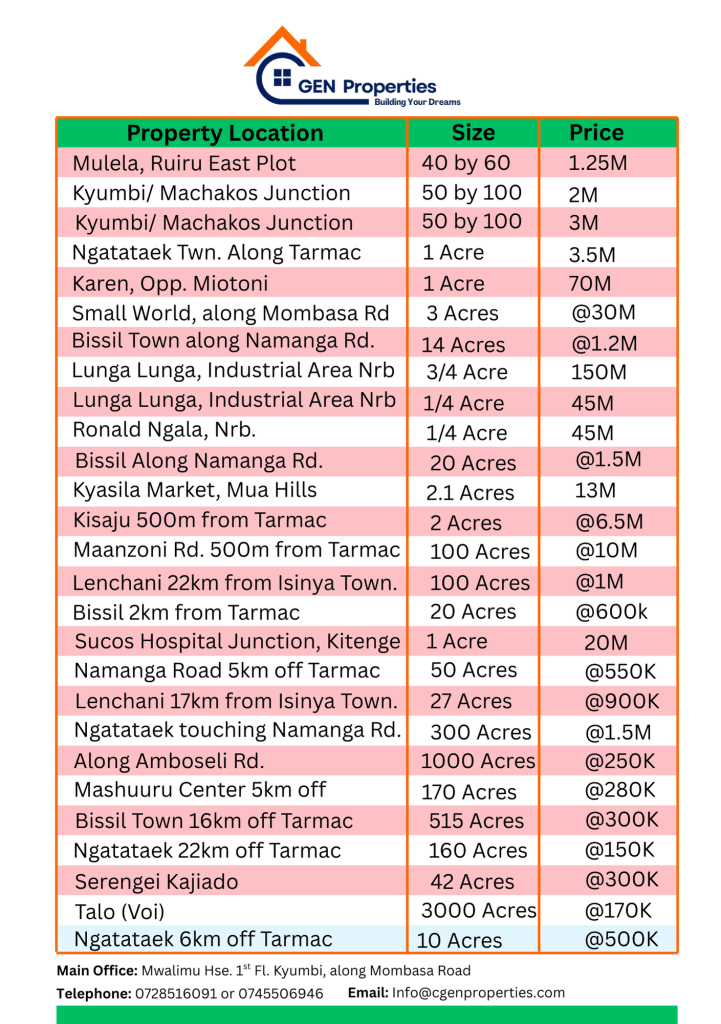
Check our properties list below.

How Much Do Lawyers Charge for Land Transfer in Kenya?

In Kenya, legal fees for transferring land are regulated by the Advocates Remuneration Order, setting a structured framework rather than fixed rates. Typically, lawyers charge between 1 % and 2 % of the property’s value, depending on the transaction’s complexity. In certain ranges—such as land priced between KSh 1 million and KSh 5 million—the minimum is commonly pegged at 2 %, with a floor fee around KSh 25,000 (Goshen Acquisitions LTD, novaprime.co.ke). More broadly, legal costs usually land between 1 % and 3 % of the value (Njaga & Co. Advocates LLP).

On top of the base fee, a 16 % Value-Added Tax (VAT) is mandatory (Goshen Acquisitions LTD, Njaga & Co. Advocates LLP). Additionally, clients must budget for disbursements—expenses such as title searches, consent applications, photocopying, and transport—that can range from about KSh 5,000 to KSh 100,000, depending on the transaction (Njaga & Co. Advocates LLP, cmpropertydigest.com).

In summary, legal fees for land transfer in Kenya generally fall between KSh 10,000 and KSh 100,000 or more, based on property value, the advocate’s rates, and transaction complexity. Always ask your lawyer for a clear breakdown of these costs—including VAT and disbursements—upfront.

At Cgen Properties Kenya, we not only connect you with genuine land deals but also guide you through every legal process, ensuring smooth and stress-free transfers. Contact us today for trusted assistance in land buying, selling, and transfers.

Call/WhatsApp: 0728 516 091

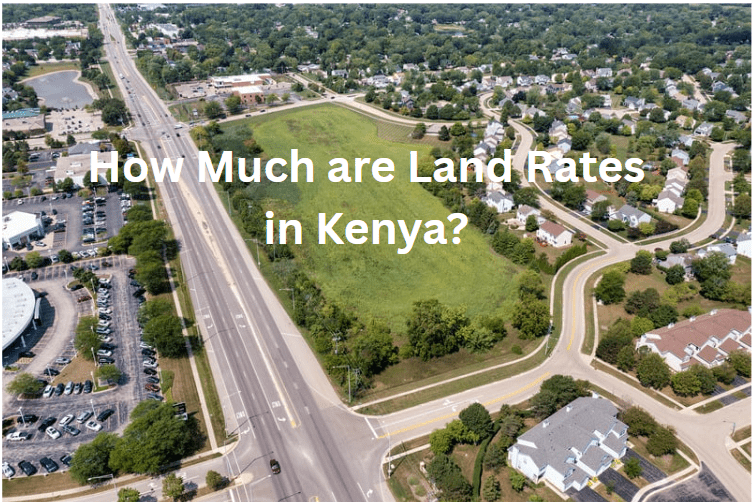
How Much are Land Rates in Kenya?

Land Rates in Kenya: Complete 2025 Guide | CGEN Properties

Land Rates in Kenya: Complete 2025 Guide

Everything You Need to Know About Property Rates Calculation, Payment, and Exemptions

Understanding Land Rates in Kenya

Land rates are annual taxes levied by county governments on all parcels of land within their jurisdictions. These rates fund essential public services like roads, waste management, street lighting, and other community infrastructure.

Important Update: Nairobi County has announced revised land rates effective January 1, 2025, with rates based on land size and value.

Whether you own residential, commercial, or agricultural land in Kenya, understanding land rates is crucial to proper property management and avoiding legal complications. This comprehensive guide covers everything you need to know about land rates in Kenya for 2025.

How Land Rates Are Calculated

Land rates in Kenya are typically calculated as a percentage of your property’s value or as a fixed amount based on land size, depending on the county’s valuation system.

Nairobi County Rates (2025)

Nairobi County has implemented a new rate structure starting January 2025:

Land Size Annual Rate
Under 0.1 hectares KSh 2,560
0.1 – 0.2 hectares KSh 3,200
0.2 – 0.4 hectares KSh 4,000
Over 0.4 hectares KSh 4,800
Residential, commercial, agricultural (value-based) 0.115% of property value

Other Counties

Other counties have different rate structures. For example:

  • Machakos County has its own valuation roll published in March 2025
  • Kajiado County published fixed rates in their Finance Act 2023, with updates expected following the National Rating Act 2024
  • Each county government determines its own rates based on local requirements

How to Pay Land Rates

Kenyan county governments offer multiple payment options for land rates:

Online Payment

The most convenient method through county portals or eCitizen platform. Nairobi County uses Nairobi Pay, while Machakos uses MachaPay.

Bank Deposit

Make payments directly to county bank accounts through interbank transfers or direct deposit.

County Offices

Traditional payment at county cash offices, where you receive immediate receipt confirmation.

Online Payment Process

  1. Register on your county’s e-payment portal or eCitizen
  2. Navigate to the land rates payment section
  3. Enter your title deed number and property details
  4. Verify the amount due
  5. Make payment via M-Pesa, debit card, or credit card
  6. Download and print the payment confirmation receipt

Land Rates for Apartment Owners

The Sectional Properties Act 2020 and National Rating Act 2024 have clarified land rate responsibilities for apartment owners:

  • Each apartment unit owner is directly responsible for their proportionate share of land rates
  • Developers and management companies are absolved of this responsibility once sectional titles are registered
  • Rates are calculated based on the unit value plus the owner’s share of common areas
  • Common areas themselves are not rated separately
Note: Apartment owners must create individual rates accounts with their county government and should not rely on management companies to handle rate payments.

Exemptions and Remissions

Certain properties are exempt from land rates under the National Rating Act 2024:

  • Freehold agricultural land
  • Public-purpose land (churches, cemeteries, public schools, hospitals, museums, dams)
  • Partial exemptions for places of worship with profit-making sections (only worship space exempted)

Applying for Relief

Property owners can apply for remission (relief) from land rates under reasonable circumstances:

  • Applications must be submitted before or within 14 days after the due date
  • Counties must respond within 30 days
  • Relief may include discounts or waiver of penalties

Enforcement and Consequences

County governments have strengthened enforcement mechanisms under the National Rating Act 2024:

⚠️ Penalties

Defaulters face penalties based on the current Central Bank interest rate

⚖️ Legal Action

Counties can sue to recover debts, place charges on properties, or appoint receivers

🏚️ Property Auction

In extreme cases, counties can auction properties at market value to recover unpaid rates

Additionally, counties may refuse to provide services like business permits or approvals until land rates are current.

Frequently Asked Questions

What is the difference between land rates and land rent in Kenya? +

Land rates are taxes levied by county governments on the capital value of properties to fund local services. Land rent is paid to the national government for leasehold properties only. Both require clearance certificates as proof of payment.

How can I pay my land rates online in Nairobi? +

You can pay Nairobi land rates through the eCitizen platform or Nairobi County’s online portal. Register an account, enter your title details, and make payment via M-Pesa, debit card, or credit card. The system generates a payment receipt immediately.

What happens if I don’t pay my land rates in Kenya? +

County governments can impose penalties based on Central Bank interest rates, deny county services, place a charge on your property, or eventually auction it to recover unpaid rates. Recent legislation has strengthened enforcement mechanisms.

Are there any exemptions from paying land rates in Kenya? +

Yes, exemptions include freehold agricultural land, public-purpose land (churches, cemeteries, public schools, hospitals, museums), and dams. Partial exemptions may apply to certain properties at the county government’s discretion.

How often are property values reassessed for land rate calculations? +

The National Rating Act 2024 requires county governments to revalue properties at least every five years to ensure rates reflect current market values. Property owners should check their county’s valuation roll for updated assessments.

Ready to Invest in Land with Confidence?

At CGEN Properties, we ensure all our properties have verified title deeds and cleared land rates. Our experts handle all due diligence so you can invest with peace of mind.

Explore our curated selection of prime land opportunities across Kenya with guaranteed authenticity.

Contact Us Today View Available Properties

Information Sources

This guide was compiled from the following official sources:

Please note that land rate policies may change. Always verify current rates with your local county government office.

5 Factors Driving the Value of Your Property in Kenya

Written by Eng. Macharia

Real estate can seem like a mystery to those who don’t understand what drives its growth. In economics, rent is considered the return for the use of land, which is one of the fundamental factors of production.

But what about a dormant piece of land in a suburban area? How does its value suddenly skyrocket? Today, it may be worth less than half a million Kshs, but in two years, it could be selling for three times that amount. Recently, I attended a real estate conference in Nairobi featuring industry experts, and one major topic stood out: What truly drives property value?

While many factors influence land appreciation, here are five key elements that determine how much your property will be worth in the coming years. If you’re an investor or aspiring homeowner, these are non-negotiable factors you must pay attention to. Let’s dive in.

1. Development

You’ve probably heard that development is a game-changer for most properties. Let’s consider an example:

“Do you know the government has started building a tech hub in Konza City?”

This is how property value skyrockets—through development. Whether it’s a government-backed project, private estates, or commercial infrastructure, development transforms a location from ‘rural’ to ‘prime land.’

Take Konza Technopolis as an example. Once considered a remote area, the government’s smart city initiative has attracted investors, tech firms, and infrastructure projects, significantly increasing land prices. Similarly, areas around Tatu City and Syokimau have witnessed a surge in value due to large-scale developments.

2. Currency and Inflation

Even when the Kenyan Shilling was more stable, land prices still appreciated. So, what happens when the shilling depreciates? Real estate becomes the safest way to store wealth.

Between 2020 and 2024, the Kenyan Shilling weakened against major currencies, but land in strategic locations appreciated significantly.

For example, if you had Kshs 1 million in savings in 2020, its purchasing power today would be much lower due to inflation. However, if you had invested that amount in land in places like Juja or Kitengela, your property value would have grown exponentially.

3. Time

They say time heals all wounds, but in real estate, time is the wealth builder. The future is always cheaper today than it will be tomorrow. Looking back 10 years, land in Ruaka was selling for as low as Kshs 500,000 per acre. Fast forward to today, and the same piece of land is valued at over Kshs 20 million.

Why? Time. The earth isn’t expanding, but the population is growing. More people need land, yet the supply remains limited. The longer you wait, the more expensive it becomes.

4. Infrastructure Development

One of the biggest drivers of property value in Kenya is infrastructure development. New roads, highways, and rail networks make previously inaccessible areas more attractive for development.

For instance, the construction of the Nairobi Expressway has drastically improved property values along Mlolongo, Syokimau, and Westlands. Similarly, the Standard Gauge Railway (SGR) made areas like Mombasa Road and Athi River more accessible, boosting land prices.

5. Demand and Population Growth

Kenya’s urban population is rapidly increasing, fueling demand for housing and commercial spaces. Cities like Nairobi, Mombasa, and Kisumu continue to attract a rising number of people seeking employment and business opportunities.

High demand in places like Ruiru, Thika, Kitengela and Ngong has led to land price surges, making them prime areas for investment.

Final Thoughts

Real estate is one of the few investments where patience rewards you. If you’re considering buying a property in Nairobi, Mombasa, or any strategic location, you must pay attention to these driving factors to make an informed investment.

In the coming decades, development, currency stability, time, infrastructure, and population growth will continue shaping real estate value in Kenya. They may affect your property differently, but they all work together to increase your return on investment.

Also Read// How to verify the authenticity of your Title Deed in Kenya?

Have you witnessed a real estate boom in a particular location? Share your thoughts in the comment section!

Should You Buy an Apartment, Build a Standalone Home, or Settle in a Gated Community in 2025?

When it comes to finding the perfect place to call home, the options are as diverse as the Kenyan real estate market itself. Do you go for the convenience of an apartment in the heart of the city, roll up your sleeves and build your dream home from scratch, or find a cozy balance in a serene gated community? Each option comes with its own set of perks—and plenty of pitfalls.

Before you make this life-changing decision, it’s essential to dive deeper into the realities behind the sales brochures and glossy advertisements. Are you looking for freedom, convenience, or long-term value? This guide unpacks the pros, cons, and hidden truths about buying, building, or living in a gated estate. Read on to discover which option truly fits your lifestyle and future plans!

Buying an Apartment

For many people, apartments seem like a convenient choice, particularly in major urban centers like Nairobi, Mombasa, and Kisumu. They offer proximity to work, schools, and essential services, which is a big plus in cities where traffic congestion is a daily battle. However, beneath this convenience lie significant challenges that many apartment owners only discover after the purchase.

Enjoy

10% Off on house plan Today

2 bedroom House Plan on Sale for 25,000 Kshs. Call 0728516091
4 bedroom Flat Roof Design on Sale for 35,000 Kshs. Call 0728516091
3 bedroom House Plan on Sale for 35,000 Kshs. Call 0728516091

One of the most significant issues is the persistent service charge. What looks like home ownership on paper can sometimes feel like long-term renting. Monthly service charges—which cover shared amenities such as security, garbage collection, and maintenance of lifts or generators—can be steep, often rivaling what tenants pay for rent. Additionally, these charges are not always transparent or under the direct control of homeowners, leading to frustrations when funds are mismanaged or the services fail to meet expectations.

Another problem with apartments is the bureaucracy that comes with shared facilities. When something like the lift breaks down or the generator fails, fixing it often requires collective agreement and financial input from multiple residents. This can lead to delays, disagreements, and unnecessary stress. Moreover, apartments restrict your ability to customize your home. You can’t easily knock down walls, install solar panels, or expand your space to suit your personal preferences.

Privacy is also a major concern in apartment living. Thin walls, shared spaces, and the close proximity of neighbors mean you’re always aware of what’s happening around you—whether it’s someone stomping on the floor above you, dragging furniture in the middle of the night, or banging doors at odd hours. If you have children, you’ll quickly realize that apartments are rarely designed with them in mind. Play areas are either non-existent or inadequate, leaving kids without safe spaces to enjoy outdoor activities. For adults, the lack of personal outdoor space means no chance of having a quiet gazebo, planting fruit trees, or even hosting a barbeque without restrictions.

While apartments might suit young professionals, singles, or couples who prioritize convenience and proximity to city amenities, they come with undeniable trade-offs in freedom, comfort, and long-term cost efficiency.

Building Your Dream Home

If the idea of full control over your living space appeals to you, building your own home might be the ideal option. This choice allows you to design a space tailored to your specific needs, preferences, and lifestyle. You can decide on everything from the layout and size of the rooms to the materials used and the features included, such as solar panels, water tanks, or a garden for growing vegetables and fruits.

However, building a home comes with significant challenges. The upfront costs are daunting, especially when you factor in the price of land, construction materials, and labor. Even in areas on the outskirts of Nairobi, such as Juja, Syokimau, or Rongai, where land is relatively affordable compared to the city center, purchasing a plot and developing it requires a substantial financial commitment.

Moreover, building a home is a time-intensive process. Managing contractors, ensuring quality control, and navigating the legal and regulatory requirements can be overwhelming, particularly for someone without prior experience. Delays, budget overruns, and unexpected complications are common, making it a potentially stressful endeavor.

That said, the benefits of owning a standalone home are undeniable. Once complete, you’ll enjoy unparalleled freedom and privacy. You can expand the house or modify it as your needs evolve, plant a lush garden, or build a gazebo where you can relax after a long day. For families, a standalone home provides children with ample outdoor space to play and explore, something apartments rarely offer.

While building your dream home requires patience, careful planning, and financial discipline, it is often the most rewarding option in the long run. It represents a true investment in your future, offering both independence and room for growth.

Settling in a Gated Community

For those seeking a middle ground between the independence of a standalone home and the convenience of an apartment, gated communities present an attractive option. These planned developments offer a balance of privacy, security, and shared amenities, making them a popular choice for families and professionals alike.

One of the primary advantages of living in a gated community is the controlled environment. Unlike apartment complexes where service charges can feel arbitrary, homeowners in gated communities often have more say in how funds are managed and allocated. This transparency and collective decision-making ensure that shared facilities, such as roads, playgrounds, and security systems, are well-maintained.

Security is another significant benefit. Gated communities typically feature perimeter walls, controlled access points, and 24/7 security personnel, offering residents peace of mind. Unlike apartments, these communities provide ample outdoor spaces, including parks, playgrounds, and walking paths, creating a conducive environment for families with children.

However, gated communities aren’t without their drawbacks. While they offer more autonomy than apartments, they still come with restrictions. Homeowners’ associations (HOAs) often impose rules on renovations, parking, and noise levels, which can feel limiting to some residents. Additionally, houses in gated communities tend to be more expensive than standalone homes in similar locations, given the added value of shared amenities and security.

For many, though, the trade-offs are worth it. Gated communities combine the sense of community found in apartments with the independence and privacy of standalone homes, making them an ideal choice for families seeking a secure and comfortable living environment.

How to Conduct a Land Search in Kenya

Buying land in Kenya can be an exciting investment, but it’s crucial to confirm the legitimacy of the property and ownership details. This guide outlines two stress-free methods for conducting a land search—online and manual—ensuring you deal with the rightful owner, whether an individual or a real estate company.

How to Conduct a Land Search in Kenya

1. Online Land Search in Kenya

This is the easiest and most convenient method, as it can be completed remotely using a smartphone or computer.

Steps to Follow:

  1. Scan the title deed to have a digital copy ready.
  2. Log in to your eCitizen portal and select the Ministry of Land, Housing, and Urban Development option.
  3. Navigate to the “Land Search” section and enter the title deed number.
  4. Fill out the online form, verify the details, and submit.
  5. Pay the required fee (Kshs 500) via mobile money (e.g., M-Pesa) or debit card.
  6. Once payment is confirmed, you will receive a detailed search result, which you can print or access later through your eCitizen account.

2. Manual Land Search in Kenya

This traditional method involves visiting the land registry office in the county where the property is located.

Steps to Follow:

  1. Prepare the following documents:
    • A copy of the title deed
    • The seller’s KRA PIN
    • The seller’s national ID
  2. Visit the nearest land registry office and request Form RL 26 (Land Search Form).
  3. Fill out the form and attach copies of the required documents.
  4. Submit the form to the registry and pay the search fee as directed.
  5. Depending on the registry’s workload, you may receive the search results within a few hours or up to three working days.

The results will help you confirm the land’s ownership details, size, and status, enabling you to make an informed decision.

Also Read// How to verify the authenticity of your Title Deed in Kenya?

How to verify the authenticity of your Title Deed in Kenya?

How to Verify Authenticity of Your Title Deed in Kenya | CGEN Properties

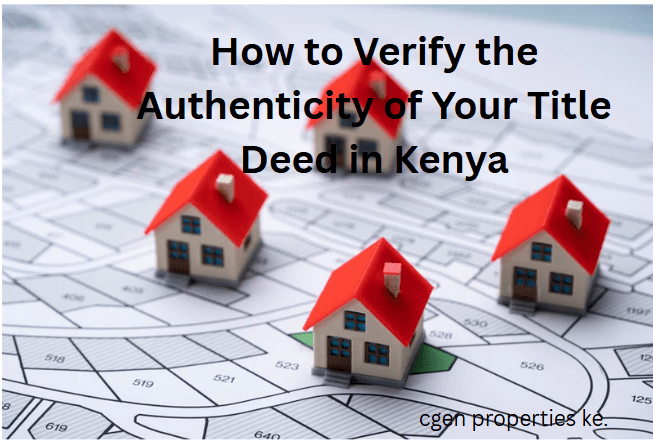
How to Verify the Authenticity of Your Title Deed in Kenya

Complete Guide to Protecting Your Property Investment with CGEN Properties

Why Title Deed Verification is Crucial in Kenya

A title deed is the most important legal document proving ownership of property or land in Kenya. Without legitimate documentation, you cannot rightfully claim ownership. Unfortunately, the market is flooded with fake title deeds designed to defraud unsuspecting land buyers.

Warning: Property fraud through fake title deeds remains a significant problem in Kenya. Always verify before purchasing any land or property.

This comprehensive guide will walk you through the step-by-step process of verifying your title deed’s authenticity through physical inspection, online verification, and manual search methods.

Physical Verification of Title Deed

Genuine Kenyan title deeds have specific physical characteristics that are difficult to forge. When examining a title deed, look for these features across its four pages:

Page Key Features to Verify
First Page Title deed number, government seals and watermark, estimated land size, map sheet number, owner’s name and National ID number, ownership type (absolute or leasehold), registrar signature and stamp, documentation date
Second Page Section A (property) and B (proprietorship), parcel number, owner details, registrar signature and official stamp
Third Page Incumbrances section showing any liens on the land such as court cases, loans, and mortgages
Fourth Page Title deed number and document serial number

Document Quality Check

Ensure the document meets these quality standards:

  • Clear printing with good font size—no smudging or inconsistencies
  • Serial numbers on all pages must match exactly
  • All pages must be signed by the land registrar with an official stamp clearly showing

Online Verification via eCitizen Platform

The Kenyan government has digitalized land records, allowing for online verification through the eCitizen platform. Follow these steps:

Create an Account

Visit the eCitizen portal and create an account if you don’t already have one. You’ll need your national ID and personal details.

Access Lands Services

After logging in, select the Ministry of Lands and choose “Land Search” from the menu options.

Enter Title Details

Enter the title deed number you want to verify and complete the online search form with accurate information.

Make Payment

Pay the required fee using M-Pesa, debit card, or credit card. The current fee for an online search is typically KSh 500.

Receive Results

Search results are usually available within 1-3 days. You can download and print the official search report.

Manual Verification at Ministry of Lands

For those who prefer or require in-person verification, you can visit the Ministry of Lands offices. This method allows you to access the original records and consult with lands officers directly.

Required Documents

  • Copy of the title deed you want to verify
  • Copy of your KRA pin certificate
  • Your ID document (original and copy)
  • Your contact details (phone number, postal address, email)

Process

  1. Visit the Ministry of Lands offices during working hours
  2. Fill out an application form requesting an official search
  3. Submit the form along with required documents and pay the fee
  4. The lands office will process your request and provide official search results
Professional Tip: It’s always advisable to physically visit the land registry where the title deed is registered and conduct due diligence before purchasing property, without involving the seller.

Green Card Verification

For comprehensive verification, ask to see the green card (for freehold properties) or white card (for leasehold properties) at the local land registry. These cards contain the original records of all transactions relating to a parcel of land.

  • Green Card: Used for freehold properties, domiciled at the local land registry
  • White Card: Used for leasehold properties, domiciled at both Ardhi House in Nairobi and the district land registry

Matching the information on these cards with the title deed you’re verifying provides an additional layer of authentication beyond the standard search methods.

Red Flags: Signs of a Fake Title Deed

Watch for these warning signs that may indicate a fraudulent title deed:

  • Missing or mismatched serial numbers across pages
  • Poor print quality, smudging, or inconsistent fonts
  • Missing government seals, watermarks, or registrar stamps
  • Discrepancies between the physical document and official records
  • Pressure from the seller to complete the transaction quickly
  • Unwillingness of the seller to allow proper verification
  • Significant price below market value

If you encounter any of these red flags, proceed with extreme caution and consider consulting a property lawyer before continuing with the transaction.

Frequently Asked Questions

What is the difference between a green card and white card in Kenya land records? +

A green card is used for freehold properties and contains original transaction records for a parcel of land. A white card is used for leasehold properties and is registered at both Ardhi House in Nairobi and the district land registry.

How long does an online title deed search take in Kenya? +

The online title deed search through the eCitizen platform typically provides results within 1-3 days after successful payment submission.

What are the main physical security features of a genuine Kenyan title deed? +

Genuine Kenyan title deeds have four pages with specific features: government seals and watermarks on the first page, registrar signatures and stamps on all pages, matching serial numbers, and no smudging or inconsistencies in printing.

Can I verify a title deed without the owner’s knowledge? +

Yes, you can conduct a title search at the Ministry of Lands offices or through eCitizen without the owner’s knowledge or involvement, which is recommended for independent verification.

Why should I verify a title deed before purchasing property in Kenya? +

Verification protects you from fraud, ensures the seller is the legitimate owner, reveals any encumbrances like mortgages or court cases, and provides peace of mind that your investment is secure.

Secure Your Property Investment with CGEN Properties

Why risk your hard-earned money on fraudulent land deals? Let our experts handle the verification process for you and ensure your property investment is safe and secure.

We offer complete property verification services and genuine land opportunities throughout Kenya.

Contact Us Today View Available Properties
Scroll to Top